Thermometers Logic Puzzles
A Designer’s First Look: Clean, Clever, and Quietly Confident
When I opened Thermometers Logic Puzzles for the first time, I didn’t see just grids—I saw potential real estate on a linen tea towel, subtle charm on a baby onesie, or quiet wit stitched onto a minimalist tote bag. As an embroidery designer who tests hundreds of graphics each year for client work and my own small shop, I’m always scanning for what *lands*: Does it hold up at 3 inches wide? Does it read clearly in satin stitch? Will customers pause, smile, and say, “Wait—what is that?” This one does.
Why It Fits Real Embroidery Projects—Not Just Printables
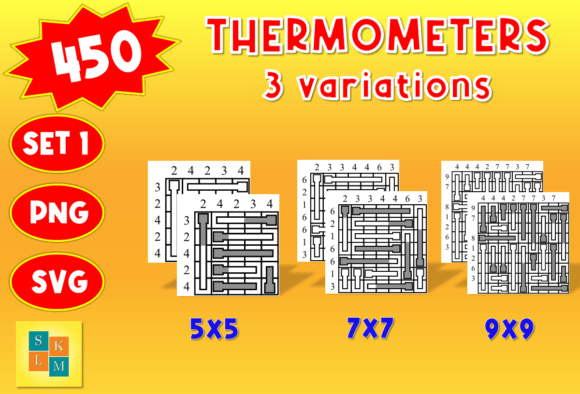
This isn’t a decorative flourish—it’s a functional graphic with personality. The 5×5, 7×7, and 9×9 variations give real flexibility: the smallest works beautifully as a pocket accent on a child’s apron or a corner detail on a holiday pillow cover; the 9×9 holds its own as a centerpiece on a sweatshirt back or a boutique kitchen towel. I tested a scaled-down version (7×7) on a medium-weight cotton blend tote—and the clean lines, consistent spacing, and balanced negative space translated cleanly into fill stitch without overcrowding or bleeding.
What stood out was how naturally Thermometers Logic Puzzles leans into handmade storytelling. It feels smart but approachable—ideal for educators, science-loving parents, puzzle enthusiasts, or indie gift shops curating “thoughtful over trendy” merchandise. I can easily imagine it stitched in tonal ecru thread on oatmeal canvas (for a nursery wall hanging) or in crisp navy on a white baby blanket—subtle enough for heirloom quality, distinctive enough to spark conversation.
Where It Shines—and Where You’ll Want to Pause
Thermometers Logic Puzzles performs best on stable, medium-to-heavy fabrics: denim, twill, linen, quilting cotton, and midweight knits (with proper cutaway stabilizer). On a custom embroidered sweatshirt for a local math camp, it held clarity even after three rounds of washing—no fraying, no distortion. As a machine embroidery design, it avoids overly tight corners or micro-details that snag threads on textured surfaces.
But here’s where practical judgment kicks in: avoid using the 9×9 variation on curved surfaces like caps unless you’re confident in your digitizing adjustments—or better yet, stick to the 5×5 for structured headwear. Thin or highly stretchy fabrics (like lightweight jersey or rayon challis) need extra stabilization and tighter tension control; test first. Dark fabric backgrounds demand high-contrast thread—especially for the thermometer “mercury” bars, which rely on visual weight, not color alone. And while the design is inherently scalable, pushing the 5×5 below 2.2 inches risks losing legibility in fill stitch—so keep that in mind for baby embroidery or tiny embroidered patches.
Stitching Clarity = Customer Trust
In my experience, buyers don’t just buy a design—they buy confidence in the finished product. When Thermometers Logic Puzzles stitches cleanly, it signals craftsmanship. No jagged edges. No floating threads. No areas where fill stitch collapses into mush. That consistency builds trust—especially for Etsy sellers offering personalized gifts or small shop owners branding reusable shopping bags. It also supports brand cohesion: whether you’re selling science-themed nursery decor or STEM-inspired teacher appreciation items, this design reinforces a calm, intelligent aesthetic—no shouting, no clutter.
Practical Notes Every Embroidery Designer Should Check
- Test on scrap fabric first—especially if pairing with textured weaves or dark backgrounds.
- Review stitch density: logic puzzles rely on contrast between filled and empty cells—ensure your fill stitch isn’t so dense it flattens dimension, or so sparse it reads as faded.
- Confirm hoop size compatibility: the 9×9 variation likely requires a 5×7 hoop minimum—verify before batching production.
- Inspect small details under magnification: thermometer bulbs and scale ticks must remain distinct at final size.
- Mock it up in black and white before choosing thread colors—this design lives or dies by tonal separation.
- Use appropriate stabilizer: cutaway for knits, tear-away for stable wovens, and consider topping for napped fabrics like terry cloth.
- Check licensing: since this is listed under Kdp Interiors as a Graphics product, confirm whether commercial use (e.g., selling finished embroidered totes or digital embroidery files) is permitted—don’t assume.
More Than a Puzzle—It’s a Design Asset With Range
I recently used the 7×7 version in a set of holiday embroidery kits for craft fair shoppers—paired with simple instructions and coordinating thread cards. Customers loved that it felt “different” from typical seasonal motifs, yet still warm and giftable. One buyer emailed saying her engineer husband wore the embroidered sweatshirt to work and got three compliments before lunch. That’s the quiet power of Thermometers Logic Puzzles: it doesn’t shout—it invites. It fits seamlessly into custom apparel, boutique branding, printable mockups for digital product previews, and even layered embroidery projects when combined with minimal text or border motifs.
For creative entrepreneurs building a cohesive line—say, educational kids’ wear or thoughtful home goods—it’s a rare find: a digital embroidery file that supports both personal joy and professional polish. It’s not flashy. It’s not trying to be everything. But as a machine embroidery design, it delivers exactly what it promises: clarity, charm, and quiet intelligence—stitched to last.