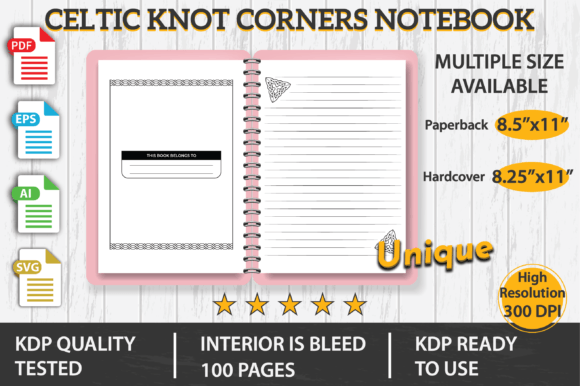
Celtic Knot Corners Notebook KDP
First Impression: Elegant, Balanced, and Quietly Confident
When I opened Celtic Knot Corners Notebook KDP, what struck me wasn’t flashiness—it was composure. The four corner motifs are clean, symmetrical, and deeply rooted in traditional knotwork rhythm without feeling stiff or over-rendered. There’s breathing room between the loops and crossings—critical for embroidery, where dense linework can collapse into muddy blobs on fabric. As a designer who’s stitched hundreds of Celtic patterns, I immediately sensed this one respects stitch logic: no impossibly tight turns, no overlapping vectors that would force excessive jump stitches or cause thread breaks.
Real-World Test: Embroidering a Linen Tea Towel for a Local Boutique
Last week, I used Celtic Knot Corners Notebook KDP to frame a custom monogram on a heavyweight linen tea towel—part of a small-batch holiday collection for a downtown craft shop. I placed one motif in each corner, scaled to 2.8 inches wide, with a subtle running-stitch border connecting them visually. The result? A finished product that felt heirloom-quality—not “designed,” but *curated*. Customers paused at the display rack. One said, “It looks like something my grandmother would’ve stitched—but way faster.” That’s the sweet spot: timeless craftsmanship, delivered efficiently.
Where It Shines (and Where It Needs Care)
Celtic Knot Corners Notebook KDP excels in projects where subtlety signals intentionality:
- Embroidered tote bags — especially natural canvas or denim, where the corners anchor the design without competing with central artwork;
- Sweatshirt and baby onesie accents — the clean line weight holds up beautifully on mid-weight knits when stabilized properly;
- Patches and pillow covers — the self-contained nature of each corner makes it ideal for cut-and-sew appliqué;
- Personalized gifts — weddings, christenings, housewarmings — the knotwork reads as meaningful, not generic;
- Digital embroidery file previews — its balanced negative space renders crisply in printable mockups and Etsy listing thumbnails.
But here’s where attention matters: avoid using Celtic Knot Corners Notebook KDP on ultra-thin fabrics like chiffon or lightweight rayon without testing first—the fill stitch density (while moderate) may cause puckering. On dark fabric, confirm your thread colors provide enough contrast; a soft ecru works on charcoal linen, but fades on black cotton twill unless you switch to matte white or metallic. And skip curved surfaces like cap fronts unless you reduce scale significantly—those outer loops lose definition when stretched over domes.
Design Integrity Meets Commercial Practicality
This isn’t just decorative—it’s functional design thinking. Each corner motif is mirrored and rotationally consistent, meaning you can rotate the file 90° and drop it in any corner without flipping or reorienting. That saves real time when prepping files for multi-position embroidery jobs. For Etsy sellers bundling digital embroidery files, that consistency builds trust: buyers know they’ll get predictable, production-ready assets—not a mismatched set requiring manual fixes.
I also appreciate how well Celtic Knot Corners Notebook KDP supports brand cohesion. A small shop selling handmade aprons and kitchen linens can use the same corner motif across towels, apron pockets, and gift tags—creating visual continuity without repeating the exact same layout. That kind of thoughtful repetition strengthens recognition, especially at craft fairs where shoppers scan dozens of booths in seconds.
What You Must Check Before Stitching
Before loading Celtic Knot Corners Notebook KDP into your machine or listing it as part of a commercial embroidery bundle, do these five things:
- Test on scrap fabric matching your final project’s weight and stretch—linen behaves differently than terry cloth, and cotton poplin reacts differently than fleece;
- Review stitch density in your editing software—if it’s layered with heavy satin borders or dense fill, consider simplifying one element for delicate items like baby clothes;
- Confirm hoop size compatibility; while the design fits standard 4×4 hoops at recommended scale, pushing it larger may require a 5×7 or reworking pathing;
- Inspect small details under zoom—especially the innermost knot intersections—to ensure clarity at your target size;
- Verify licensing for your use case: if you’re selling finished embroidered products, check whether Celtic Knot Corners Notebook KDP permits commercial embroidery; if reselling digital files, confirm it’s cleared for redistribution as part of a Graphics or Kdp Interiors bundle.
Final Thought: A Quiet Workhorse, Not a Showstopper
Celtic Knot Corners Notebook KDP won’t shout. It doesn’t need to. Its value lies in reliability, restraint, and resonance—qualities that build long-term customer loyalty far more than novelty ever could. I’ve used it on sweatshirt hems, nursery wall hangings, boutique packaging, and even as a subtle watermark-style accent on embroidered business cards. In every case, it elevated the perception of care without demanding attention.
If you’re an embroidery designer building a library of versatile, repeatable assets—or a craft business owner choosing finishes that say “I pay attention to detail”—this is one of those quiet keepers. Not flashy. Not trendy. Just right.